
 Hugames Minesweeper
Minesweeper: complete game example
Here is an example of a simple game at the Beginner level that helps you understand the basics of the game as well as logical deductions.
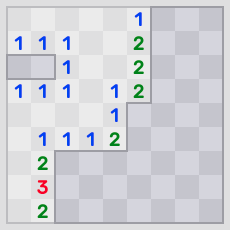 Example of the grid at the start of the game.
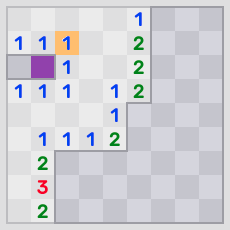 The
1
marked here in orange has only one unrevealed adjacent square:
the square marked in purple. We can therefore place a flag
on this purple square.
The
1
marked here in orange has only one unrevealed adjacent square:
the square marked in purple. We can therefore place a flag
on this purple square.
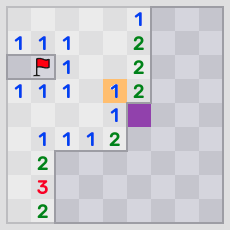 Same thing here: the
1
tells us that we can place a flag on this other purple square.
Same thing here: the
1
tells us that we can place a flag on this other purple square.
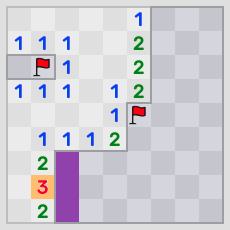 Now let's look at the
3
marked in orange: it has only three unrevealed adjacent squares.
All three must therefore be mines: we can place three flags,
one on each purple square.
Now let's look at the
3
marked in orange: it has only three unrevealed adjacent squares.
All three must therefore be mines: we can place three flags,
one on each purple square.
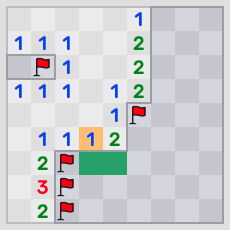 Here, we can see that the
1
on the square marked in orange already has a flag on an adjacent square.
We can therefore deduce that the two squares marked here in green do not contain a mine.
We can then left-click (normal click) on these two squares.
Here, we can see that the
1
on the square marked in orange already has a flag on an adjacent square.
We can therefore deduce that the two squares marked here in green do not contain a mine.
We can then left-click (normal click) on these two squares.
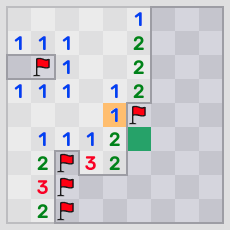 Same observation here: the
1
lets us determine that there is no mine on the green square.
Same observation here: the
1
lets us determine that there is no mine on the green square.
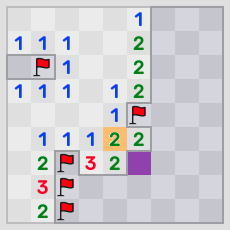 Now, the
2
lets us deduce that there is a mine on the purple square.
Now, the
2
lets us deduce that there is a mine on the purple square.
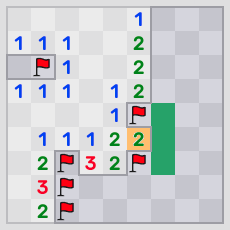 Here, we can see that the
2
marked in orange already has two flags on its adjacent squares.
We can therefore click on these three squares.
Here, we can see that the
2
marked in orange already has two flags on its adjacent squares.
We can therefore click on these three squares.
Pro tip: rather than clicking on these three squares one by one, we can click directly on the 2 ! The game will understand that we want to clear the adjacent squares, which will save two clicks and a little time on the final score. This trick only works when all the flags have been placed around a number.
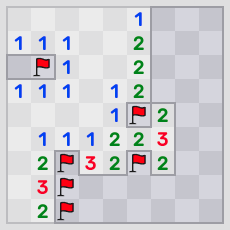 Here is the current state of the game.
Here, we cannot deduce where the mines are on the right side of the board using the previous techniques. We have to make guesses.
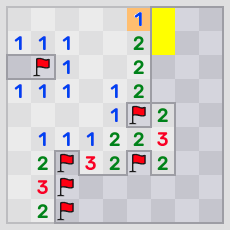 Let's look at the
1
marked in orange. It lets us deduce that there must be a mine
on one of the two squares marked here in yellow. We will explore both hypotheses.
Let's look at the
1
marked in orange. It lets us deduce that there must be a mine
on one of the two squares marked here in yellow. We will explore both hypotheses.
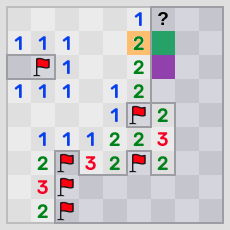 If there is a mine on the square marked with a question mark, we can deduce
that there is no mine on the green square.
If there is a mine on the square marked with a question mark, we can deduce
that there is no mine on the green square.Then, using the 2 marked in orange, we can deduce that there is a mine on the purple square.
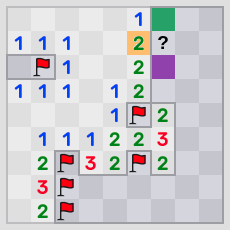 Now let's look at the other hypothesis and mark the supposed location of the mine. In this case, the square marked in green does not contain a mine.
And the
2
marked in orange lets us deduce that there is a mine on the purple square.
Now let's look at the other hypothesis and mark the supposed location of the mine. In this case, the square marked in green does not contain a mine.
And the
2
marked in orange lets us deduce that there is a mine on the purple square.
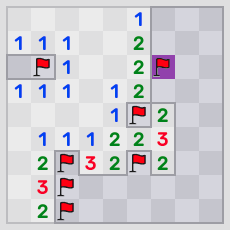 By comparing the two hypotheses above, we can see that in both possible cases,
the purple square contains a mine.
By comparing the two hypotheses above, we can see that in both possible cases,
the purple square contains a mine.
We are therefore now certain that this square contains a mine. We can place a flag on it.
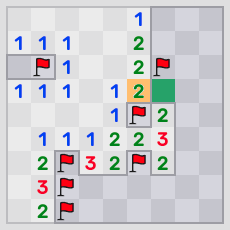 Let's continue with the usual logic. The
2
tells us that there is no mine on the green square.
Let's continue with the usual logic. The
2
tells us that there is no mine on the green square.
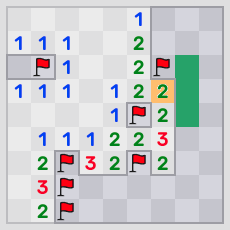 Same thing here.
And as seen earlier, we can click on the orange square to clear all three green squares in one go.
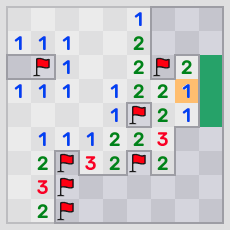 Same thing here: let's click on the
1
to clear the three green squares.
Same thing here: let's click on the
1
to clear the three green squares.
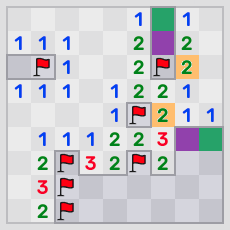 Let's continue. With the usual logic, we can clear the green squares here
and place a flag on the purple squares.
Let's continue. With the usual logic, we can clear the green squares here
and place a flag on the purple squares.
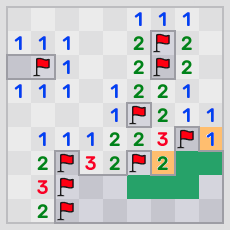 We can clear all the green squares here.
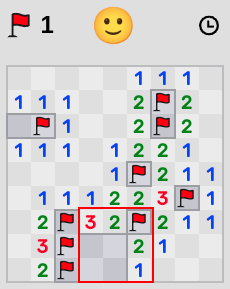 Here is the current state of the game. Unfortunately, in the area outlined in red,
we cannot precisely deduce where there are mines and where there are none.
Here is the current state of the game. Unfortunately, in the area outlined in red,
we cannot precisely deduce where there are mines and where there are none.
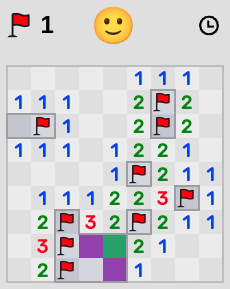
There are indeed two possibilities...
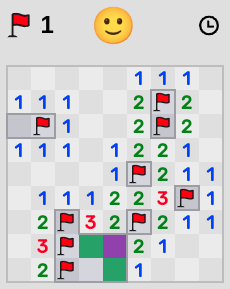 Possibility 1: one mine on the purple square, and no mine on the two green squares.
 Possibility 2: two mines on the purple squares, and no mine on the green square.
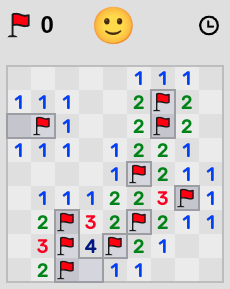 But we have another useful clue: the remaining mine counter!
It tells us that there is only one mine left to locate. Possibility 2 can therefore be ruled out.
We can then go with possibility 1!
But we have another useful clue: the remaining mine counter!
It tells us that there is only one mine left to locate. Possibility 2 can therefore be ruled out.
We can then go with possibility 1!
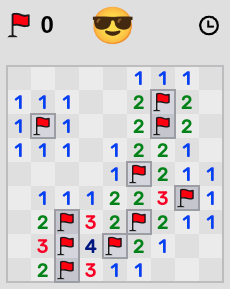 We have now placed all the flags, and the counter at the top left shows 0 mines remaining.
Yet the game is not over (and the timer is still running!)
To complete the game, you still need to click on the two remaining unrevealed squares. The game ends when all squares without a mine have been revealed. Note that, conversely, it is not necessary to place all the flags to win. Flags help us understand the situation, but it is the revealed squares that trigger the end of the game.
If you have taken it all in, you now have everything you need to play Minesweeper at the Expert level!
Play Minesweeper Online :